Choosing when to reserve a UK hotel is less about finding a universal “best” day and more about balancing three practical needs: acceptable room and date availability, terms you can live with if plans move, and any live offer that genuinely fits the stay you want. That balance looks different for a fixed business trip, a school-holiday break, or a weekend whose dates are still fluid.
How booking timing affects value and flexibility
AI-generated generic editorial illustration — not a retailer product photo and does not depict the reviewed product or service. Visualise the timing-versus-flexibility criteria introduced in the overview.
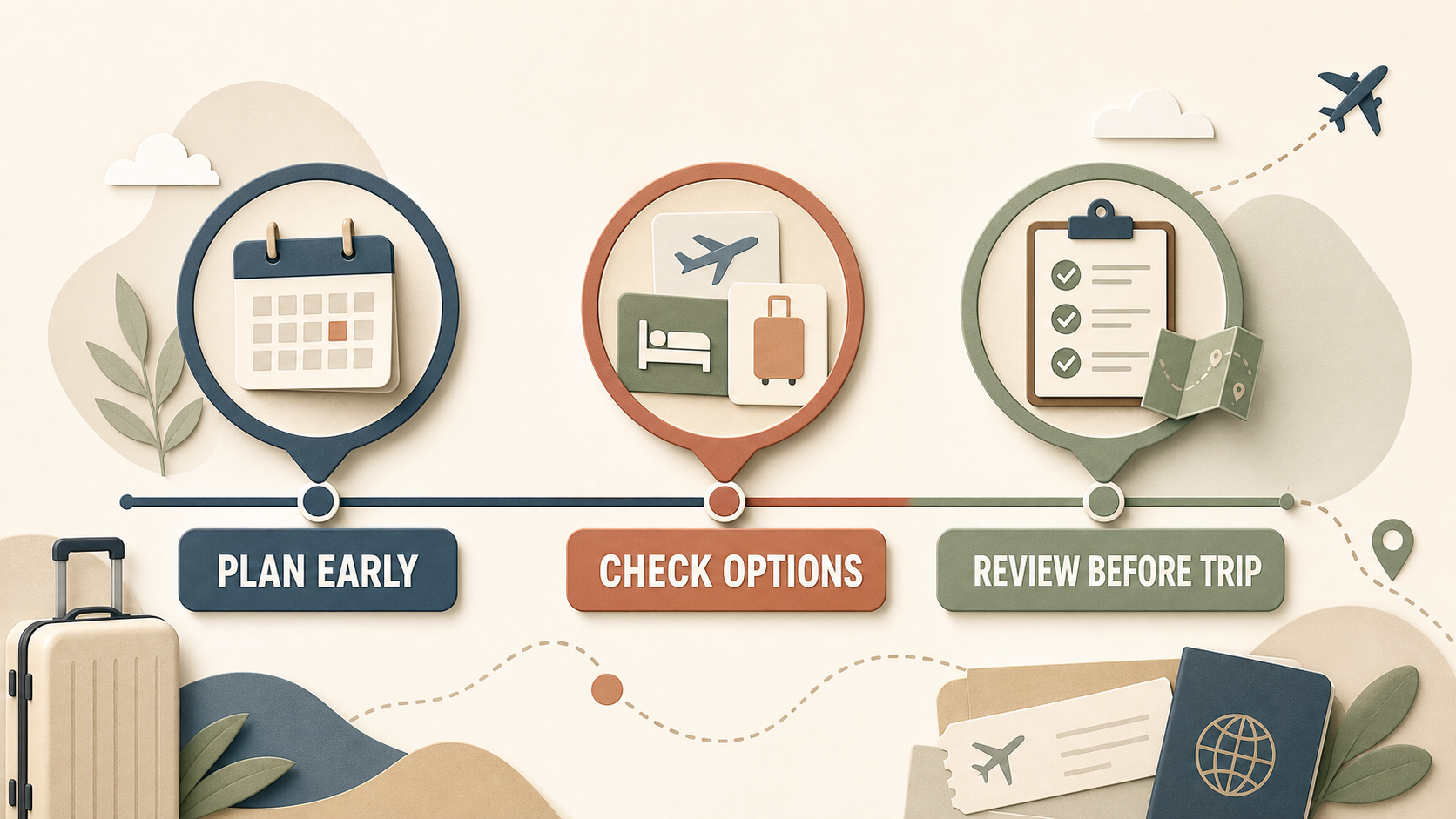 Start with the trip, not with an assumed price pattern. Write down the dates, the room features that matter, how likely the plans are to change, and the point at which you would be comfortable committing. If a particular hotel, location or room type is essential, the ability to reserve it may be more useful than waiting for a possible promotion. If the itinerary is still uncertain, the rate rules may matter more than securing the first available room.
A useful comparison has two stages. First, look for an option that meets the practical requirements of the trip. Then read the booking and promotional terms before treating the displayed rate as your final choice. This keeps availability, flexibility and offer eligibility separate rather than assuming that one favourable-looking price settles every part of the decision.
For some chains, advance planning has a clear operational benefit. Premier Inn states that bookings can be made up to 12 months ahead. That is a booking window, not a promise that earlier reservations will always cost less. Use it as time to compare suitable dates and room choices, then decide whether the terms match your confidence in the trip.
Book early when dates and room choice matter most
Booking earlier can be practical when your travel dates are fixed and your requirements are narrow. A traveller arranging a meeting, travelling with family, or needing a particular location may have less room to substitute dates or room types later. In those cases, starting the search well before the trip can give you more time to identify an acceptable option and complete the reservation before you need to make a rushed choice.
Premier Inn says guests can make bookings up to 12 months in advance. That published window is useful for planning a long-lead trip: you can begin checking availability once your dates are known, rather than waiting until the booking period opens. It also gives you time to compare the details of the options you can actually reserve.
Do not turn that window into a general price forecast. The fact that a booking can be made earlier does not establish that it will be cheaper than every later option. Compare the rate you see with the room, dates and conditions attached to it. If those conditions work for you, booking early may reduce uncertainty around the stay itself; if they do not, the reservation can create a different kind of risk.
Before confirming, save the room description, dates and terms you relied on. This makes it easier to check the booking later and helps you distinguish a genuine match for your trip from a rate that looked attractive but had unsuitable conditions.
Check the cost of changing plans before committing
An early reservation is only valuable if it remains workable when the trip changes. Before committing, review the rate rules that apply to the option in front of you. Focus on what you would need to do if dates change, the length of stay changes, or the hotel is no longer suitable. A booking made far ahead can be less useful when the itinerary is still provisional and the terms leave little room to adjust.
Treat the reservation as a commitment with two parts: the room you have selected and the conditions under which you selected it. A lower displayed figure should not be evaluated separately from those conditions. If a flexible option costs more, the relevant question is whether the added room to change plans is worth it for this particular trip—not whether one type of rate is always better.
After booking with Premier Inn, you are given a booking reference and the same reference appears in the confirmation email. Premier Inn says the reference can be used through its Manage Booking link to view the reservation. Keeping that reference, the confirmation email and a note of the rate conditions together creates a simple record for any later review.
If no confirmation email arrives, Premier Inn advises checking the spam filter and contacting Guest Support if one has not arrived within 12 hours. That is a practical reason to verify the reservation soon after making it, rather than discovering a missing confirmation close to departure.
Treat promotions as date-specific opportunities
AI-generated generic editorial illustration — not a retailer product photo and does not depict the reviewed product or service. Help readers evaluate published promotions as date-specific offers with conditions.
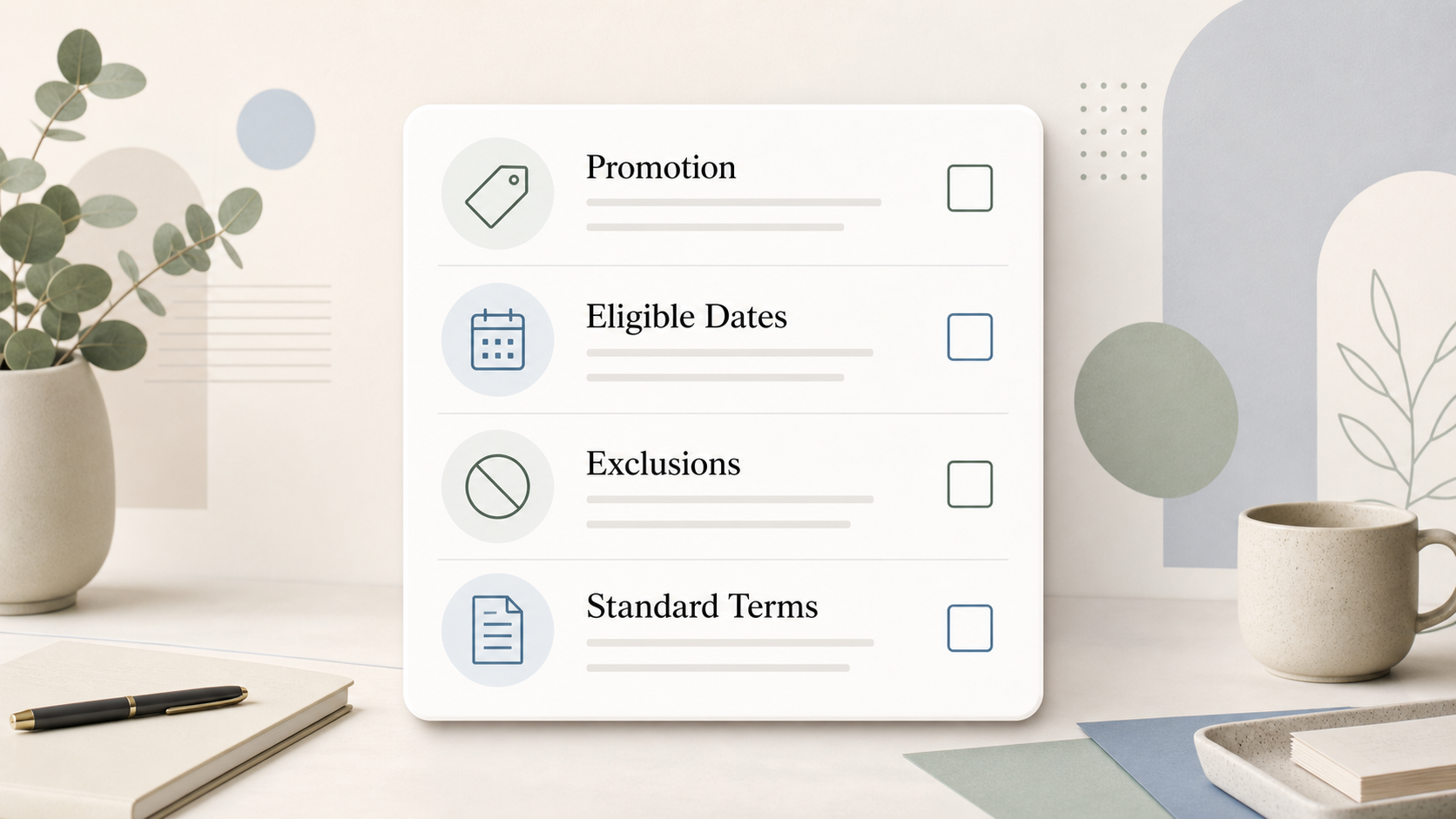 A promotion can be worth checking, but it should be read as a dated, conditional offer rather than a blanket statement about every stay. Match the advertised stay period, the hotel area and the booking channel against your intended trip before using the headline rate in your comparison.
Travelodge’s promotional terms give a clear example of why this matters. Its published “£35 or less” room-count statement is tied to the lowest available room rate, a stated stay period and a date on which the count was measured. The same terms say the quoted figure excludes hotels in Northern Ireland, Ireland and Spain, and that standard booking terms apply. Those details may change whether the promotion is relevant to a traveller’s chosen hotel and dates.
Use a short checklist when reviewing a live offer:
- Is your intended stay within the published date range?
- Is your chosen hotel or destination included?
- Does the offer describe a limited number of rooms or a lowest available rate?
- Which standard booking terms still apply?
This approach avoids two common mistakes: assuming a promotional headline applies to every night, and comparing a promotional rate with a standard rate without checking the conditions attached to each. A promotion may still be a good fit, but only after its eligibility and terms have been checked against the exact booking you want to make.
Use a two-stage booking strategy for uncertain trips
When plans are not fully settled, separate the availability decision from the final value decision. In the first stage, identify the dates, hotel location and room requirements that would make the trip workable. If an acceptable option is available and the booking rules suit your level of certainty, reserve it. If the rules would make a likely change difficult or costly, continue comparing rather than treating early action as automatically decisive.
In the second stage, review the reservation details before the trip. Check the booking reference, the confirmation email, the dates and the terms that applied when you booked. Premier Inn says its booking reference can be used to view a reservation through Manage Booking, and its confirmation email includes that reference. That gives travellers a documented way to confirm the booking has been created and revisit its details.
This two-stage method is especially useful where the trip has one fixed element and one uncertain element. For example, you may know the destination and approximate period but not the final meeting time or length of stay. The goal is not to predict whether rates will rise or fall. It is to make a choice that preserves an acceptable option while keeping the terms visible enough to reassess when the itinerary becomes clearer.
Record the booking reference in the same place as your travel dates and confirmation email. If you are comparing a live promotion, also note the offer date and the conditions you checked. A short record helps prevent a later decision from relying on a remembered headline rather than the reservation you actually made.
Choose the timing strategy that matches your trip
Use the table below as a decision aid rather than a price forecast.
| Trip situation | Timing approach | Main advantage | Main check before booking |
|---|---|---|---|
| Fixed dates and specific room or location needs | Start checking early within the available booking window | More time to find an option that meets the trip requirements | Confirm the rate conditions and save the booking details |
| Dates broadly known but itinerary still moving | Identify acceptable options, then commit only when the rules match your certainty | Keeps the decision focused on flexibility as well as availability | Review how a change in dates or length of stay would affect the booking |
| Travel that depends on a live offer | Compare the offer against the exact stay before relying on it | Helps test whether the promotion is genuinely relevant | Check dates, exclusions and standard booking terms |
Premier Inn’s published 12-month booking window can support the first approach, but it does not establish a universal early-booking price advantage. Travelodge’s published promotional terms illustrate why the third approach needs a date-by-date check: the availability statement, stay period and exclusions are all part of the offer.
Whichever route you take, complete the booking only after checking the details relevant to your stay, then retain the reference and confirmation. The strongest decision is usually the one that fits your real trip constraints without depending on an unsupported prediction about future prices.
Frequently Asked Questions
How far in advance can I book a Premier Inn stay?
Premier Inn says bookings can be made up to 12 months in advance. Use that as a planning window: begin comparing suitable dates and room options when they become available, then review the conditions of the specific rate before reserving. The stated window does not mean that booking at the earliest possible point will always produce the lowest price.
Do lower advertised hotel rates apply to every UK hotel and travel date?
Not necessarily. Travelodge’s promotional terms state that its “£35 or less” room-count figure relates to the lowest room rate available during a specified stay period and as measured on a specified date. The terms also exclude hotels in Northern Ireland, Ireland and Spain and say that standard booking terms apply. Check the live offer, intended dates, hotel and exclusions before assuming an advertised rate applies to your trip.
What should I check before booking when my travel plans may change?
Check the rate rules alongside the room and dates. Consider how likely your plans are to move and whether the booking conditions suit that level of uncertainty. Once you book, keep the confirmation email and booking reference. Premier Inn says the reference is included in the confirmation email and can be used through Manage Booking to view the reservation.
How can I confirm that a hotel booking has been made successfully?
Premier Inn says you receive a booking reference when making a booking and that the reference is also included in the confirmation email. You can use it to view the booking through Manage Booking. If you do not receive the email, check your spam filter; Premier Inn advises contacting Guest Support if no confirmation email arrives within 12 hours.
Before finalising any reservation, check the provider’s current booking and promotional terms for the exact stay you intend to make.
Sources
Related reading
- Travelodge review: who its room and rate model suits and where limits matter
- How to choose a UK hotel chain: location, room needs, rate terms and extras
- Hotel room and rate types explained: compare flexibility, extras and total stay value
- How to identify genuine hotel deals: total price, rate rules and direct-booking claims
Editorial information: About our editorial team · Read our editorial policy · Read our affiliate disclosure.